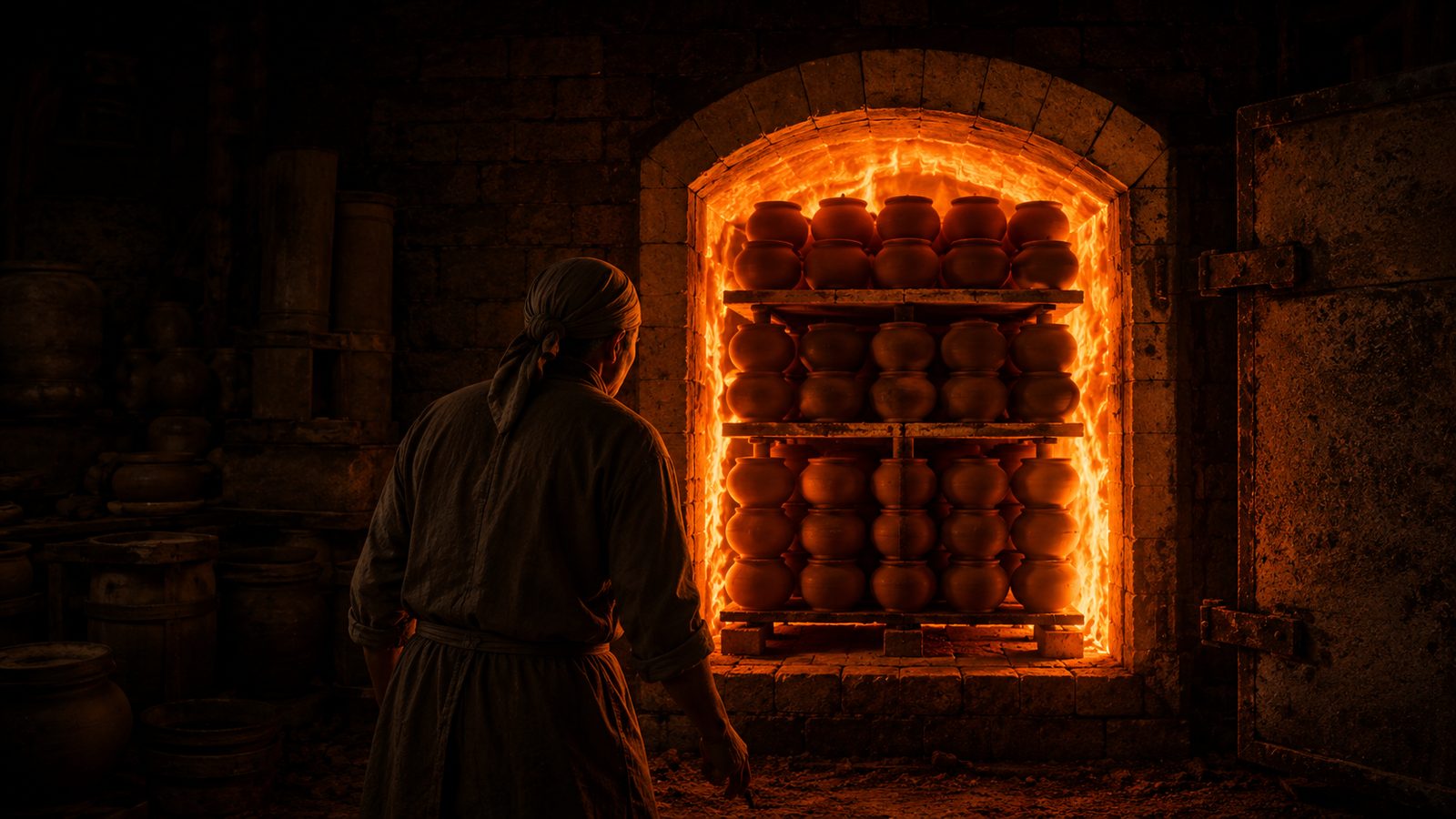
Korean sea salt, sealed inside a hwangto clay jar and fired for twelve hours. The jar is never opened again — not to sort it, not to bag it. You open it.
Born from the sea.
Shaped from Korean earth.
Roasted by fire.
Delivered in the very jar that made it.
01 How it's made
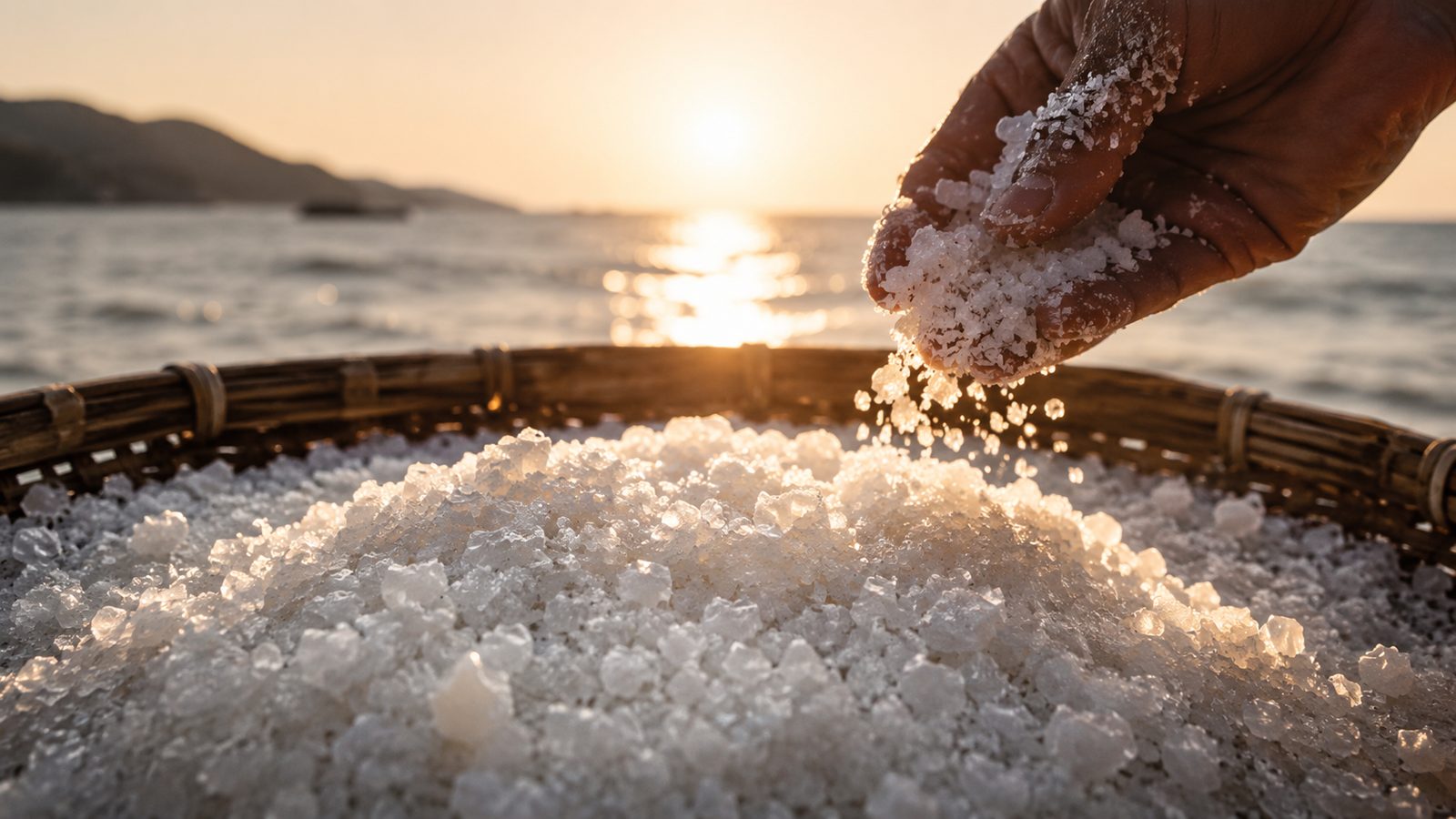
On the tidal flats of Korea's southwest coast, the water withdraws twice a day and leaves shallow beds behind. Sun and wind finish the job over weeks, not minutes. What's left is raked by hand.
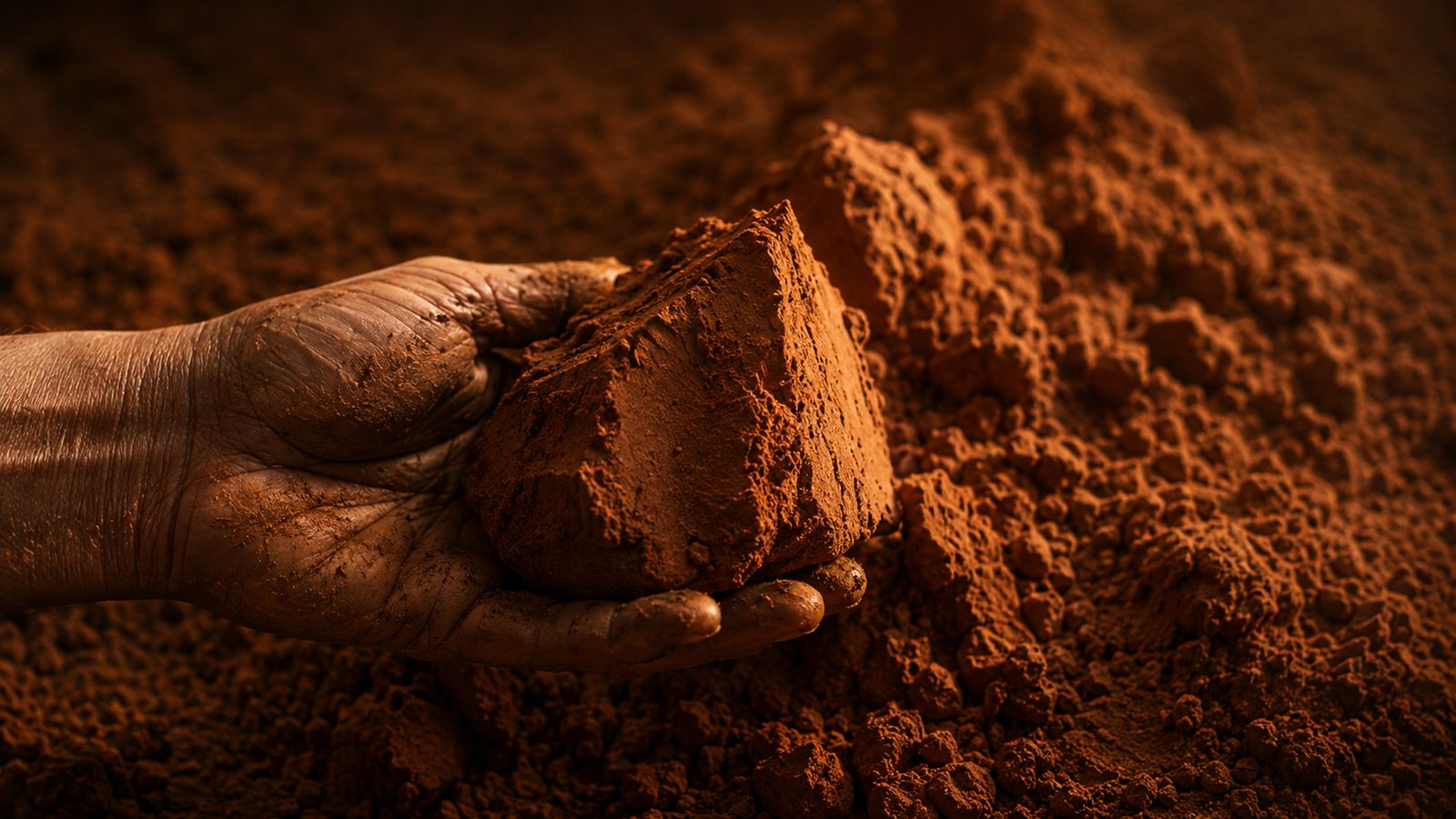
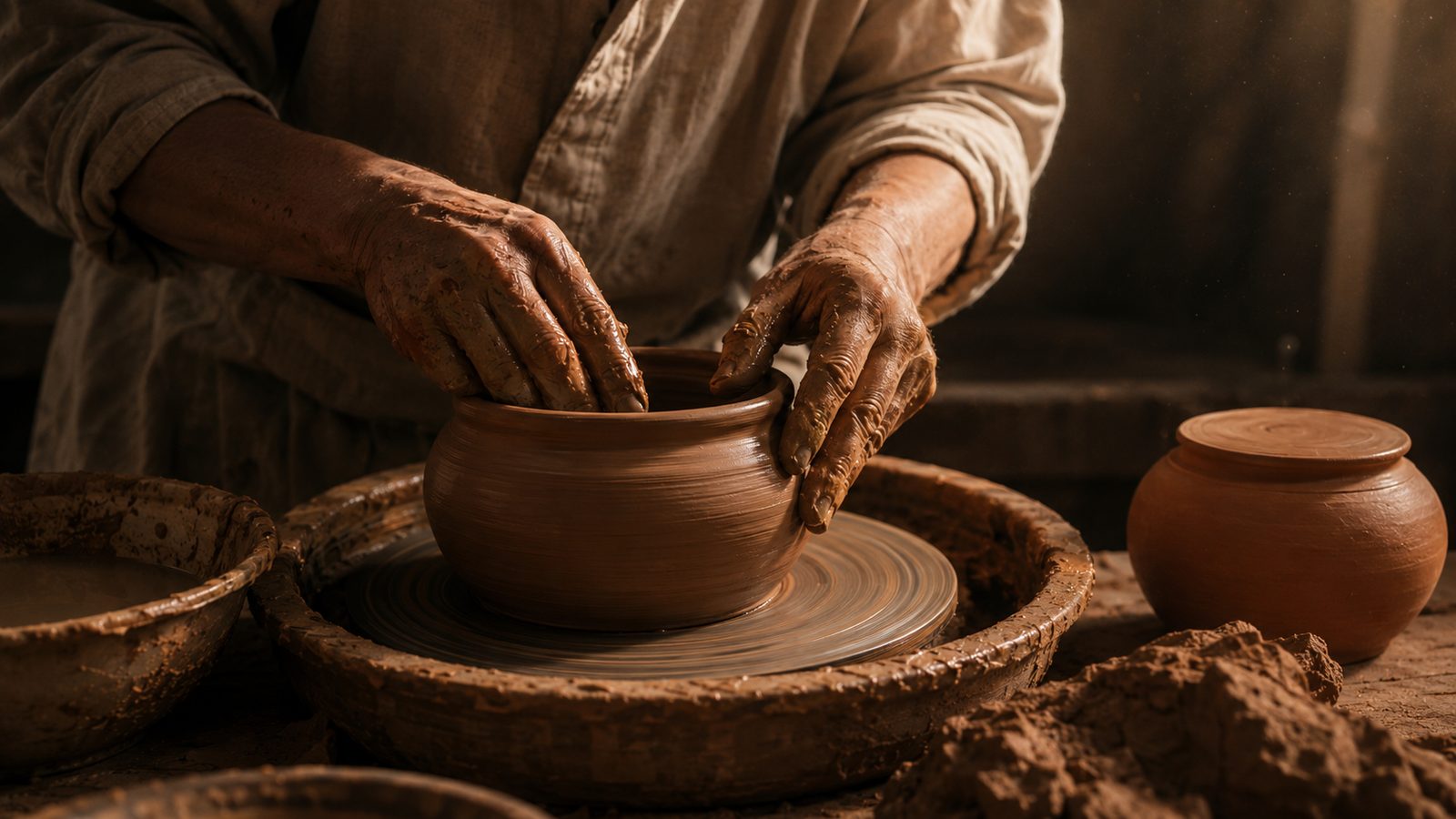
Hwangto is the iron-rich ochre earth Korean potters have thrown for a thousand years and built farmhouses from. It is never mixed into the salt.
The naturally porous earthenware creates a roasting environment you cannot get from steel or stone.
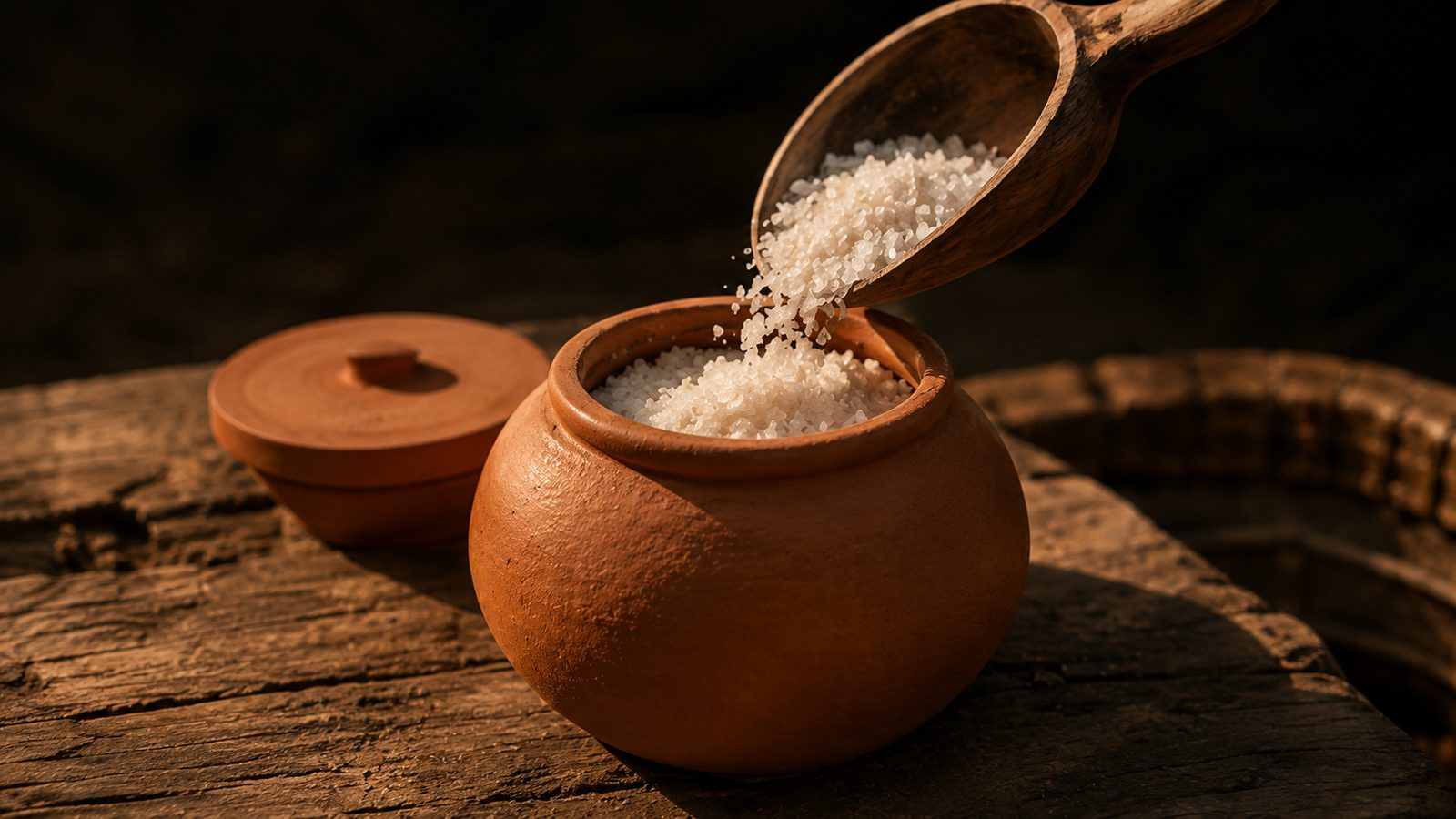
Low, round, lidded. Not a container chosen off a shelf to hold a product — a vessel made for one firing, at the size the kiln and the salt require.
Raw salt goes into the jar. From this moment the salt and the jar are a single object, and nothing will separate them again.
Paper over the mouth, clay lid on top, by hand, jar after jar. There is no line here and no machine — only the same task repeated until the kiln is full.
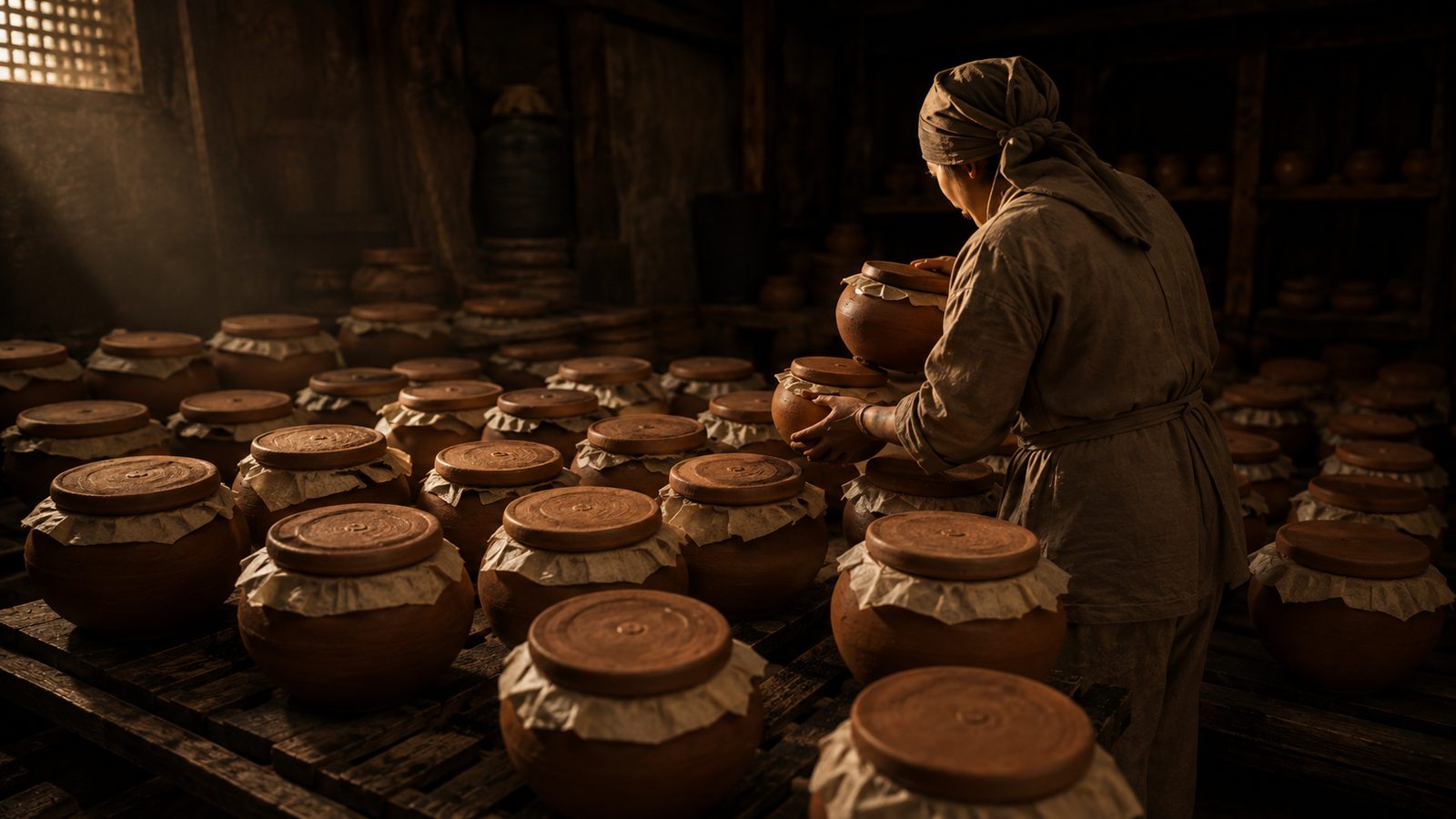
The sealed jars go into the kiln and stay there. The batch is called by the person who loaded it.
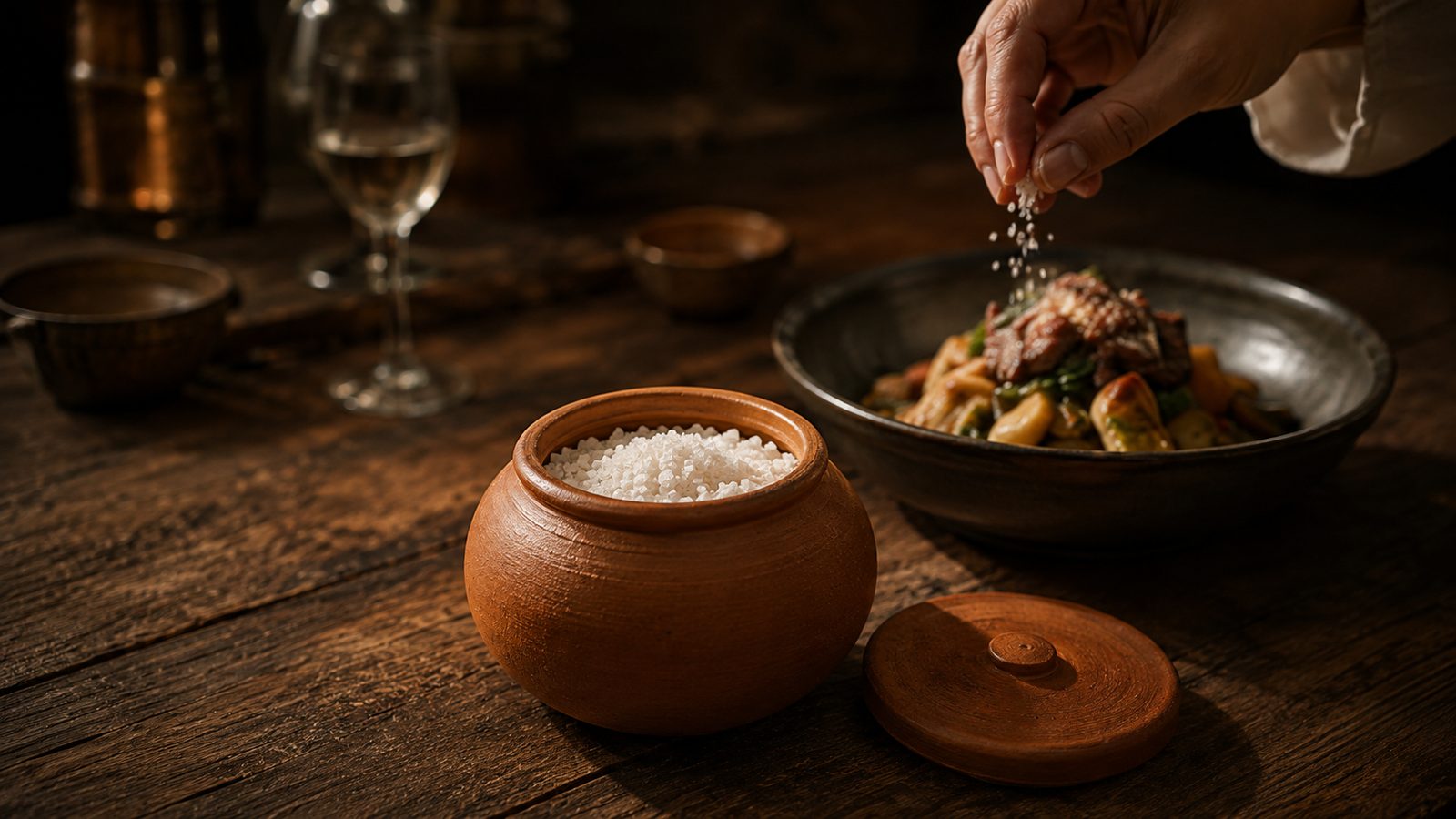
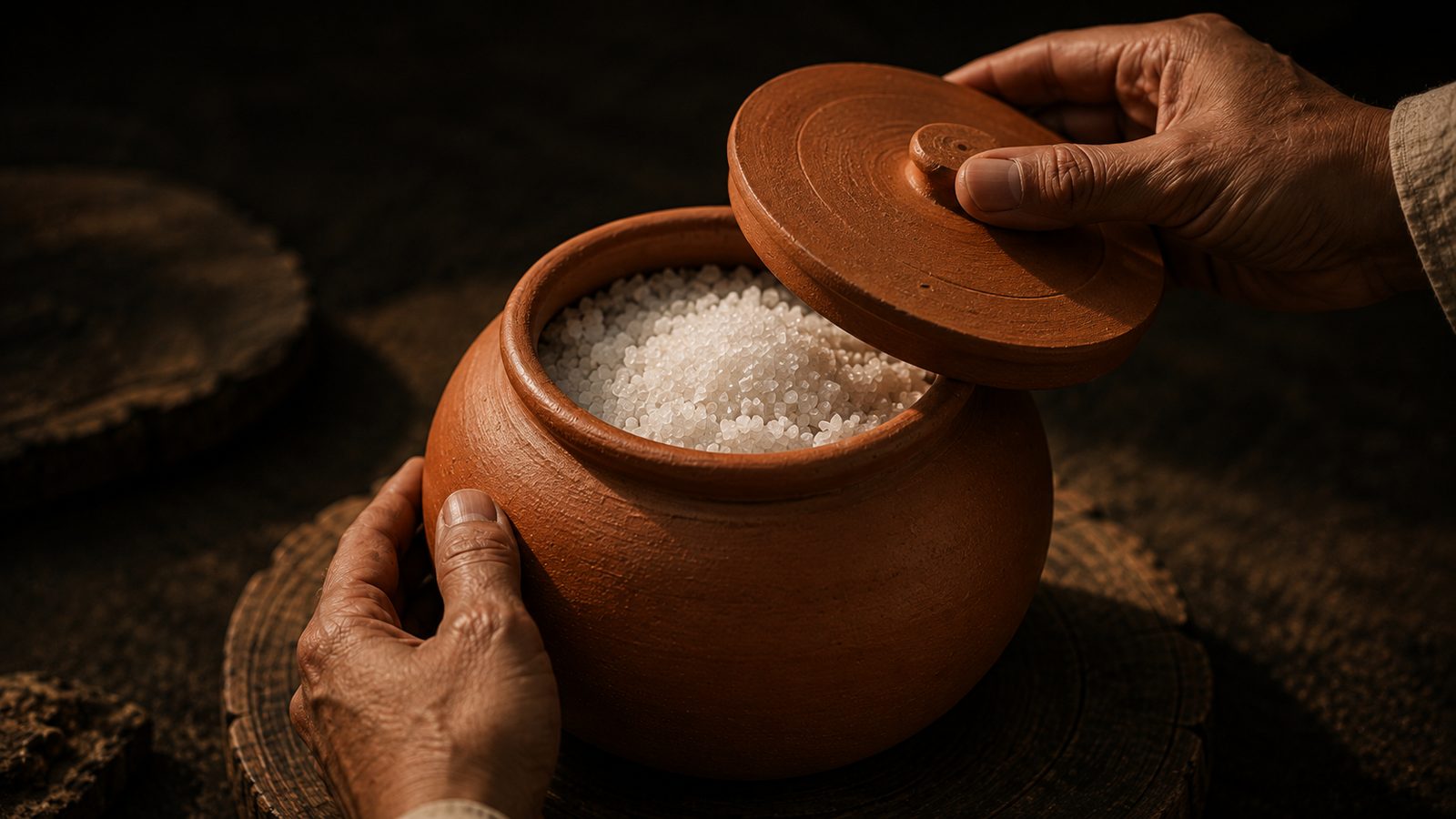
When the kiln cools, the jar isn't emptied. It isn't screened, re-dried, weighed out, or poured into a pouch. It goes into a box exactly as it came out of the fire.
The next person to open it is you.
02 Proof
A sample was shipped to Eurofins in Des Moines, Iowa — an ISO/IEC 17025:2017 laboratory, A2LA accredited — and tested for heavy metals and composition. Every line of that report is printed below, including the one that isn't a zero.
| Parameter | Result | Method |
|---|---|---|
| Heavy metals | ||
| Lead (Pb) | 0.210 mg/kg | Mwd-ICP-MS |
| Cadmium (Cd) | < 0.1 mg/kg | Mwd-ICP-MS |
| Arsenic (As) | < 0.1 mg/kg | Mwd-ICP-MS |
| Mercury (Hg) | < 0.02 mg/kg | Mwd-ICP-MS |
| Copper (Cu) | < 24 ppm | ICP |
| Composition | ||
| Sodium | 36.8 % | ICP |
| Magnesium | 1.14 % | ICP |
| Sulfur | 0.69 % | ICP-OES |
| Potassium | 0.338 % | ICP |
| Calcium | 0.128 % | ICP |
| Molybdenum | 0.065 ppm | Mwd-ICP-MS |
| Manganese | < 13 ppm | ICP |
| Selenium | < 0.25 ppm | Mwd-ICP-MS |
| Iron | < 0.005 % | ICP |
| Phosphorus | < 0.100 % | ICP |
| pH | 9.96 | AOAC 981.12 |
Lead is the only line that returned a number rather than a limit. We print it, because a report you can only read half of isn't a report. “<” means the element was below what the instrument could measure.
Eurofins Nutrition Analysis Center — 2200 Rittenhouse Street, Des Moines, Iowa. Sample received 7 August 2026, reported 17 August 2026. ISO/IEC 17025:2017, A2LA certificate 2927.01.
After the salt
Most premium salt ends its life as an empty pouch in the bin. This ends as a fired clay vessel sitting on your counter. Refill it, keep something else in it, or leave it where it is.
Korean kitchens have stored food in onggi for a thousand years — soy, gochujang, grain, kimchi. Yours will hold whatever you decide.
The makers
A small operation in Bukha-myeon, run by Yang Soon-ok. It is a certified women-owned business and, since 2026, a certified social enterprise — which in Korea means the state has verified that creating the jobs is the point, not a by-product of them.
If a jar cracks or the grain comes out wrong, it doesn't ship. That's the entire quality system.
One kiln load at a time. Batch size is limited by what the kiln holds.